

The AI market is moving fast, pushing mid-sized companies to adjust plans with little warning. Like us, you’re probably seeing sharp jumps in artificial intelligence industry growth and the rising popularity of AI, and feeling the pressure to act. Numerous obstacles stand in the way: choosing the wrong tool will drain your budget. Moving too slowly will give your competitors a clear lead. The list goes on.
We tackle these nuances every day at Aloa. We help teams pilot ideas and take them into production. We are experienced in handling data and helping you make the right decisions, not rushed ones.
This guide breaks down the signals teams study when timing their next AI steps:
- How market size and growth shape timing
- Which technologies show real traction
- Where adoption rises across industries
- A clear roadmap for 2025 through 2027
- Opportunities worth tracking and the risks tied to them
Everything here stays sharp and steady so your decisions stay strong.
TL;DR
- The global AI market nears 750 billion dollars in 2025 and may pass 3.6 trillion by 2034, with growth around 20 to 30% each year.
- Core tools like machine learning, NLP, and computer vision already deliver steady ROI, while generative AI, edge AI, and automation create the next wave of gains.
- Healthcare, finance, and tech lead adoption, while manufacturing, retail, and logistics now use AI to cut downtime, stock issues, and delays.
- A phase roadmap from 2025 to 2027 moves from pilots, to production scale, to real market advantage with clear gates and KPIs.
- Success depends on data quality, tight integration, and a small set of focused use cases, not a long list of experiments.
Current AI Market Landscape and Growth Trajectories
Artificial intelligence industry growth in 2025 brings the global AI market close to 750 billion dollars. Strong cloud platforms, wider use of generative AI, and steady adoption across daily business work drive this rise. Most forecasts expect 19 to 30% yearly growth through the next decade as more companies turn pilots into production systems.
This pace reshapes how companies plan. Budgets shift. Roadmaps adjust. New tools appear before teams finish testing the last round. When change happens this fast, timing becomes part of the strategy. Companies need solid numbers to know when to invest, where to move first, and how to stay competitive.
Three major forces power this growth:
- Data Explosion: Phones, machines, sensors, and apps create more than 2.5 quintillion bytes of data each day. AI models learn patterns from this data.
- Stronger Computing Power: Modern chips and cloud systems train AI models much faster. Workloads that once took weeks now finish in hours.
- System Upgrades: Many companies rebuild old systems, and AI becomes part of the upgrade. Once a workflow gets rebuilt, AI often improves speed, quality, or accuracy.
These forces hit at the same time and push AI adoption across different industries. At Aloa, we watch these market shifts closely because they shape how we help teams plan AI roadmaps, not one-off experiments.
Market Size Evolution
The global artificial intelligence market reached about 638 billion dollars in 2024 and is estimated at 750 billion dollars in 2025. Long-term forecasts show the market reaching 3.6 trillion dollars by 2034, with some projections rising to 4.8 trillion dollars by 2033. Annual growth rates range from 19 to 30%, depending on region and tool type.
The growth pattern follows three phases:
- Phase 1 (2024–2027): Companies test ideas and expand pilots. Teams try generative AI for writing, coding, forecasting, and customer support. Spending rises fast as companies try to learn what works before scaling.
- Phase 2 (2028–2031): AI becomes part of daily operations. Tools move into supply chains, planning, service teams, finance steps, and risk checks. AI connects more tightly to core systems.
- Phase 3 (2032 onward): Growth slows but stays steady. AI becomes a basic part of many systems, similar to how cloud tools became standard over time.
Most mid-sized companies sit in Phase 1 today. Early decisions shape how well teams scale later. Strong early work opens space for better systems. Rushed early work forces teams to fix the first wave of choices before they can move forward.
Geographic Growth Patterns
AI adoption rises at different speeds around the world because each region has its own rules, budgets, and comfort with data use:
- North America: Fast growth because many companies already run cloud systems.
- Asia-Pacific: Very fast growth due to large populations, strong investment, and rapid digital expansion.
- Europe: Steady growth under stricter data rules and longer review cycles.
- Latin America and the Middle East: Rapid expansion as cloud access improves and more key players in the AI industry enter these markets.
Regional differences matter. A system that runs smoothly in one country may need more controls or new approval steps in another. Planning rollouts region by region helps teams avoid delays and reduce risk.
Technology Maturation Indicators
Growth numbers give a snapshot, but deeper signals show whether the market stands on solid ground. Three indicators matter most:
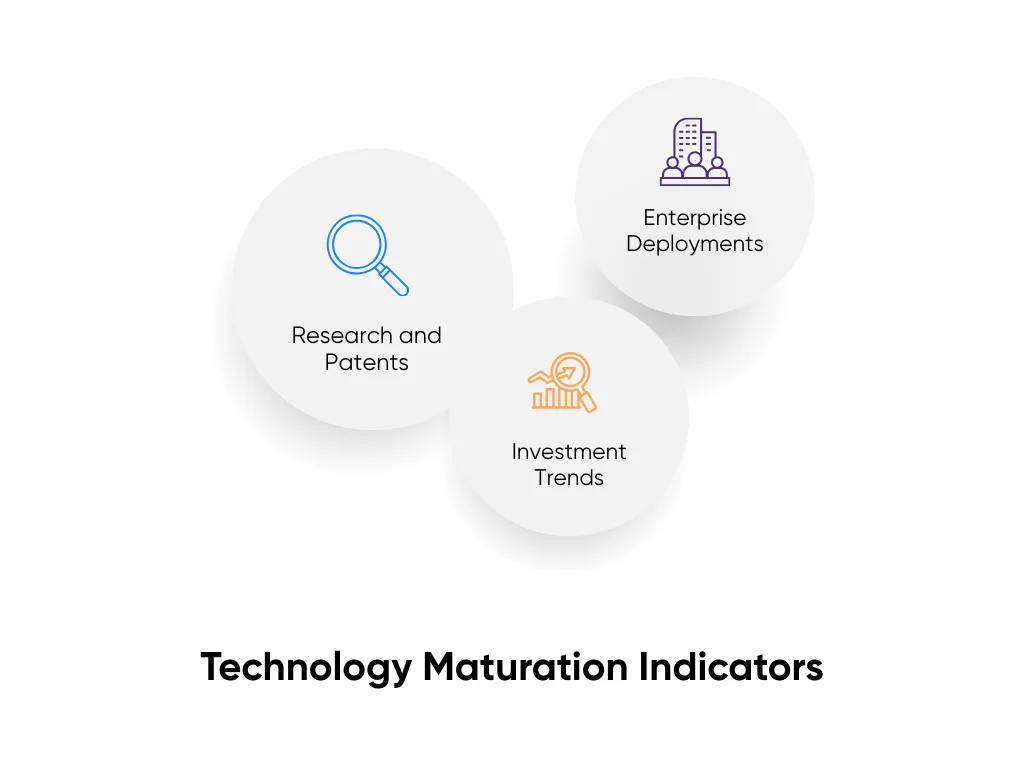
- Research and Patents: More AI research papers, patents, and open-source models appear each year. New ideas and stronger tools reach teams faster.
- Enterprise Deployments: More companies use AI in daily work instead of keeping it in pilot mode. This shows AI tools hold up under real pressure with messy data and busy teams.
- Investment Trends: Private investment keeps rising. U.S. companies invested around 109 billion dollars in AI in 2024. Many companies now build internal AI teams to support long-term work instead of only small experiments.
These signals show a market building long-term stability, not a short-term spike. They also show that strong data, clean integration, and steady monitoring still decide whether AI delivers real value.
Technology Segments and Investment Opportunities
AI usually comes into an organization in stages. First, you fix the daily slowdowns. Then you tackle work that eats too much time. After that, you connect the systems that still rely on manual steps. Each AI technology sits at a different point on this path and covers different AI use cases across the business. When you understand these differences, you choose tools that push your goals forward instead of wasting time on projects that never land.
Core AI Technologies Analysis
Most organizations start with machine learning, natural language processing, and computer vision. These AI applications solve problems that show up in almost every operation.
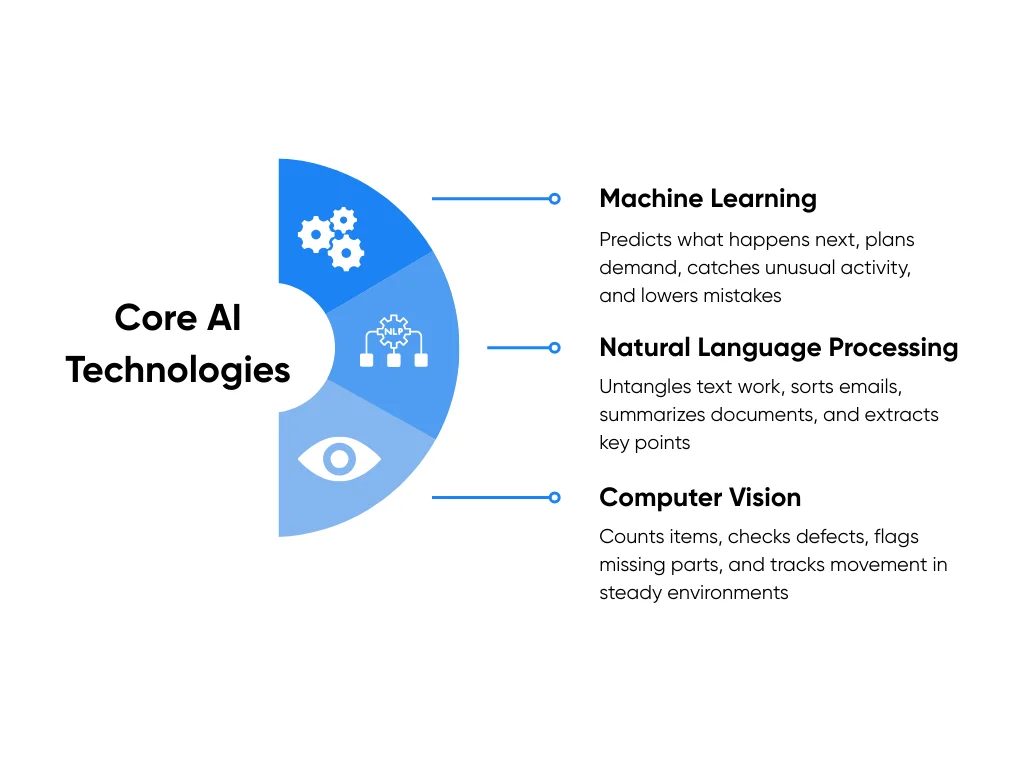
- Machine learning uses past data to predict what happens next. It helps plan demand, catch unusual activity, route work, and spot early signs of trouble. When the data stays clean, ML lowers mistakes and keeps decisions steady. It also has a mature ecosystem, so teams can roll it out with clear steps and expect early returns.
- Natural language processing untangles the text work that slows people down and powers tools like speech recognition and virtual assistants. It sorts emails, groups support messages, summarizes long documents, and pulls out key points from notes. NLP shines when the task follows a clear pattern, because it removes hours of reading and lets teams focus on action, not sorting.
- Computer vision handles anything that depends on a visual check. It counts items, checks for defects, flags missing parts, and tracks movement. Vision works best in steady environments where lighting and layout don’t change much. It needs more setup than ML or NLP, but once it fits the environment, it reduces errors and speeds up inspection work.
These core tools deliver consistent, low-risk results. They use data you already create, fit into routine work, and require fewer major changes to systems or workflows.
Emerging Technology Opportunities
After the basics settle in, organizations look at technologies that unlock bigger gains. These include generative AI, edge AI, and automation platforms. They offer strong rewards but need more structure and testing.
- Generative AI produces first drafts of content, code, and training material. It cuts out the slow “starting from zero” step. The output still needs review, but the time saved adds up fast. GenAI works best when you set limits on what it should produce and make review part of the workflow.
- Edge AI runs models on local devices instead of cloud servers. It reacts instantly, which helps in places where delay slows everything down. This matters for equipment checks, traffic flow inside facilities, or safety alerts. Edge AI sits in the early-adopter stage. It delivers strong value but needs careful testing and more technical skill.
- Automation platforms remove repetitive steps between systems. They move data, push approvals, and run routine checks without human input. Automation returns time quickly when the workflow is consistent and follows clear rules. It’s close to mainstream adoption because most operations feel the drag from manual handoffs.
These emerging tools bring higher upside, but they perform best when you start with one focused use case, measure the impact, and scale slowly.
Strategic Technology Selection Framework
A simple way to match the tool to the job:
- Machine Learning: Forecasting, scoring, and pattern-heavy work
- NLP: Reading, sorting, summarizing text
- Computer Vision: Visual checks, item counts, monitoring
- Generative AI: Drafting content or code
- Automation Platforms: Repetitive, rule-based steps
- Edge AI: Real-time decisions when network access is unreliable
Most organizations see the strongest results when they combine one core technology that fixes a daily problem now with one emerging technology that builds an edge for the future.
This mix keeps progress steady and gives you a clear path from early wins to long-term impact. We see this play out often at Aloa when we help teams decide which AI technologies belong in their stack now and which ones should wait.
Industry Adoption Patterns and Vertical Market Analysis
AI adoption moves at different speeds across industries. Some fields move quickly because timing, accuracy, and safety shape every decision. Others move slower because their data is scattered, their rules are strict, or their systems are old. Seeing these patterns helps you understand where your organization stands compared to others in your sector, and whether your pace gives you an edge or puts you behind.
High-Adoption Industries
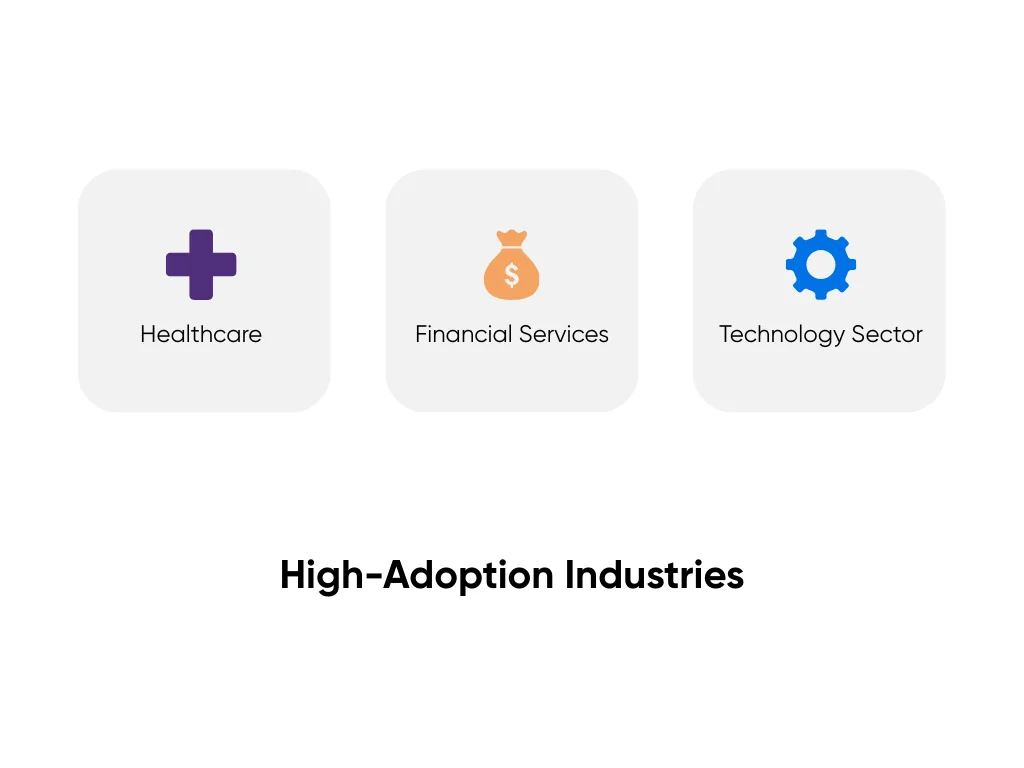
Healthcare, financial services, and the technology sector lead AI adoption. They work with large digital datasets, face strong competition, and depend on fast, reliable decisions.
Healthcare
Healthcare teams use AI to read medical images, summarize patient notes, sort cases by urgency, and predict patient flow. These tasks use structured data already stored in EHRs, imaging systems, and lab tools. AI reduces wait times, cuts documentation hours, and helps care teams find key details faster. Privacy rules slow things down, but once a workflow passes all checks, the benefits show up within weeks or months. Early adopters see smoother operations and less burnout across clinical staff.
Financial Services
Banks use AI to detect fraud, verify identities, score risk, and review documents. These tasks need speed and consistency, and AI handles patterns across millions of records without drifting. Regulations require clear decision trails, so models must stay stable and easy to audit. When controls are solid, teams see fewer false alerts, faster approvals, and less manual review. Early adopters improve loss prevention and speed up customer onboarding.
Technology Sector
Tech companies move fast because their data is already digital and organized. They use AI to generate code, improve search, support customers, and forecast usage. The challenge comes from managing quality when many teams try AI at the same time. With good monitoring, adoption spreads quickly and delivers immediate gains. AI also helps tech companies add smarter features to their products, which tightens competition across the market.
These industries lead because they already collect clean data, make fast decisions, and realize clear value when they move early.
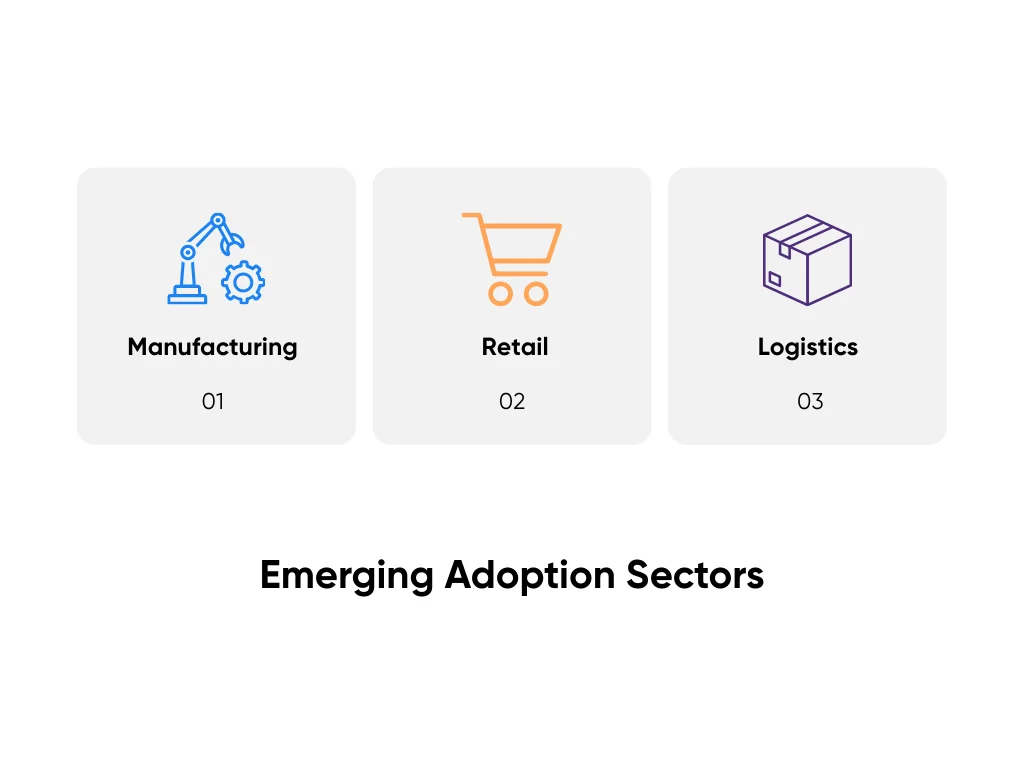
Emerging Adoption Sectors
Manufacturing, retail, and logistics are gaining speed. Their work depends on timing, accuracy, and cost control, so even small improvements make an impact.
Manufacturing
AI predicts equipment failures, checks product quality, and balances production loads. These changes reduce downtime, cut scrap, and stabilize output. Older machines sometimes produce messy data, so early projects often focus on improving sensors and logs. Once data becomes reliable, AI delivers strong results and fewer surprise shutdowns.
Retail
Retail teams use AI to forecast demand, manage stock, recommend products, and plan pricing. Small forecasting errors lead to empty shelves or excess inventory. AI helps match stock to real demand across stores and online. Older systems with inconsistent data slow things down, but once cleaned, AI improves availability, pricing decisions, and promotional performance.
Logistics
Logistics groups use AI for routing, real-time tracking, staffing forecasts, and early delay alerts. These tools boost delivery accuracy and cut costly delays. The barrier is scattered data across carriers, warehouses, and vehicles. When updates stay consistent, teams respond faster to schedule changes and keep routes efficient.
These sectors advance when AI improves timing, visibility, and predictability: three factors that shape their daily performance.
Industry-Specific Implementation Strategies
Each industry has its own rules and data needs, so rollouts must match the environment.
- Healthcare: Needs strong privacy controls and simple explanations for AI decisions. Start with low-risk tasks like note summaries or scheduling support. Track time saved and faster patient flow.
- Financial Services: Needs clear audit logs and stable models. Start with scoring, screening, or document checks. Track fewer false alerts and faster approval cycles.
- Manufacturing: Needs consistent sensor data. Start with one machine or production line. Track fewer defects, reduced downtime, and steadier cycle times.
- Retail: Needs clean product and customer data. Start with demand forecasting or recommendation models. Track forecast accuracy, stockout reduction, and stronger promo results.
- Logistics: Needs fast updates across partners. Start with routing or delay alerts. Track on-time delivery, route efficiency, and quicker response times.
Across all industries, the same three steps hold:
- Fix the data before scaling.
- Start with one clear use case tied to a real KPI.
- Expand only when the first workflow performs under real pressure.
At Aloa, we use these three steps when we build AI for healthcare, finance, education, and more. Because we’ve shipped AI systems across highly regulated and complex environments, we don’t just drop in a model and hope for the best. We design around your constraints: compliance requirements, legacy systems, fragmented data, and the people who have to use the tool every day.
With Aloa, you get:
- Clear, de-risked strategy. We help you pick the first use case, define the KPI, and map the workflow end-to-end so you’re not “doing AI” for the sake of it. You’re solving one specific, measurable problem.
- Build, pilot, then scale. We start with a tight proof of concept, pilot it with a small group of users, and only then roll it out more broadly.
- Change management built-in. We can create simple UX, clear playbooks, or training so your team knows exactly when and how to use your AI tool.
The result: your first AI workflow can already hold up in the real world. Once that’s in place, we help you rinse and repeat until AI is quietly embedded across your operations.
Implementation Roadmap for 2025-2027
AI is easiest to adopt when you follow a clear plan instead of chasing random ideas. A three-year roadmap helps you move from early tests to full operations without getting stuck or wasting time. Each year has its own goals, and you only move forward when the basics are solid.
Before entering any phase, check four readiness areas:
- Technical Setup: Do you have cloud access, secure storage, and simple monitoring?
- People: Is there someone who owns AI work and has real time to spend on it?
- Data: Do you know where important data lives and who controls it?
- Change: Do teams know who to contact with questions and how to give feedback?
If any of these fall behind, progress slows. Treat these checks as required, every year.
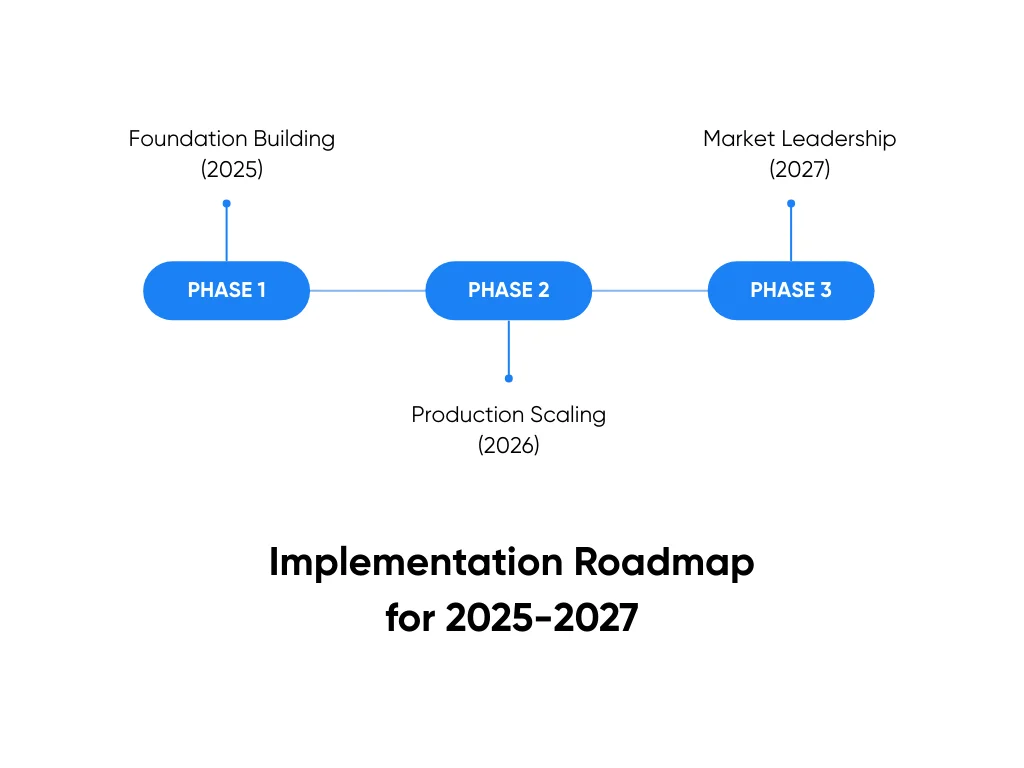
Phase 1 Foundation Building (2025)
Phase 1 is about proving AI can help your organization in real, everyday work. Keep it small and focused.
Start with the basics:
- A secure place to store and process data
- Clear rules for who can access it
- Logging so you can see what the system did and when
Then form a small AI team:
- A business owner who knows the pain points
- A technical lead who understands your data and systems
- Someone who handles training and communication
Next, pick one to three pilot projects. Each one should:
- Solve a repeatable problem
- Use data you already have
- Have one clear KPI, like “time per ticket” or “errors per batch”
- Fit into a 60- to 90-day build cycle
Think simple: ticket routing, report summaries, or basic risk flags.
Phase 1 succeeds when:
- The pilot finishes on schedule
- The KPI improves, even a little
- Users say the workflow is easier, not harder
- Nothing breaks compliance or security rules
You only leave Phase 1 when at least one pilot checks all the boxes and the team supports scaling it.
Phase 2 Production Scaling (2026)
In Phase 2, the question changes from “Does this work?” to “Can this run every day without drama?”
First, decide how you’ll deploy models:
- Pick a standard way to run them (cloud, container, platform)
- Set up monitoring for uptime, errors, and slowdowns
- Create a rollback plan in case an update goes wrong
Next, integrate AI into your existing systems:
- Your CRM or support tools
- Your planning or ERP platform
- Your reporting or analytics stack
AI that stays separate from daily tools brings little value. Integration is where real ROI appears.
Now strengthen risk controls:
- Review access to sensitive data
- Decide when humans must override AI
- Build simple playbooks for bad outputs or outages
Phase 2 focuses on scale and reliability. Track:
- How many workflows now use AI
- How much manual effort dropped
- System uptime and error rates
- How often teams use the new workflow vs. the old one
You leave Phase 2 when AI supports multiple core processes, stays stable, and your risk checks run smoothly.
Phase 3 Market Leadership (2027)
Phase 3 turns AI into a competitive advantage. The goal is not to experiment more; it’s to build smarter products and services.
Start with advanced capabilities, like:
- Large language models tuned to your industry
- Search systems that pull answers from your own content
- Real-time engines that adjust pricing, routing, or staffing automatically
Then build an innovation pipeline:
- A simple way for teams to submit ideas
- A small review group that ranks ideas by value and effort
- A steady pace of small tests each quarter
Phase 3 moves your success metrics to business impact:
- Revenue lift or margin impact
- Better customer satisfaction or retention
- Shorter time from idea to pilot
- Higher percentage of key processes with AI support
You hold a leadership position when new ideas come in, tests run quickly, strong concepts move into production, and your metrics show steady gains.
Across all three years, the rhythm stays the same: check readiness, build something focused, measure actual results, move forward only when the numbers support it. This structure keeps your roadmap grounded, avoids wasted effort, and helps your organization build AI capabilities that last.
Key Takeaways
Artificial intelligence industry growth is not a side topic anymore. It now shapes how you set budgets, design roadmaps, and judge competitors. The upside is real, but so are the risks of weak tools, rushed pilots, and vague promises.
Our view is simple. Start with one clear problem, pick the right tech for that job, and move through each phase with firm gates and real numbers. Fix the data, ship small, measure hard, then scale what works. Repeat that rhythm across your processes and you build an AI program that survives trends.
This is where we plug in. At Aloa, we help you turn plans into working systems through integration, guardrails, and ongoing measurement your leaders can trust. If you're testing ideas or deciding where to start next, we'd love to talk. You can book a working session with our team, share your biggest AI challenge in our AI Builder Community, or get steady updates from our AI newsletter.
FAQs
Which AI technologies should companies invest in for the best ROI in 2025-2027?
The strongest returns come from machine learning, natural language processing, and workflow automation because they handle work that happens every day. Machine learning predicts patterns, NLP speeds up anything involving text, and automation clears out repetitive steps. Generative AI adds value when teams spend too much time starting documents or code from scratch. Most organizations see the best results when they pair one proven technology with one newer tool instead of trying everything at once.
What industries are leading AI adoption and why?
Healthcare, financial services, and the tech sector lead because they already collect clean digital data and work under pressure where delays cost money, safety, or trust. Healthcare uses AI to shorten wait times and help with documentation, finance uses it to spot fraud and reduce review work, and tech uses it to speed up internal development and improve products.
What are realistic AI implementation timelines for mid-sized companies?
A focused pilot usually takes two to three months. Turning a working pilot into a real, daily workflow takes six to twelve months. Building a reliable AI program across multiple teams often takes one and a half to three years. Clear goals and clean data keep timelines short; older systems and unclear ownership stretch them out.
How do I know if my organization is ready for AI implementation?
You’re ready when you have a secure infrastructure, a clear owner for AI work, access to the data you need, and a simple process for collecting feedback from teams. If any of those pieces are missing, fix them first so new pilots don’t stall or cause rework.
What role will generative AI play in the AI market growth through 2027?
Generative AI will drive a large share of new adoption because it speeds up writing, coding, training, and support work. On its own, it creates quick drafts; with good data and review steps, it becomes a dependable productivity tool. Most organizations will use GenAI alongside machine learning and automation as a combined stack, not as a replacement for them.